



Cement Mixer Truck
Shandong Jutong: Your Premium Cement Mixer Truck
Supplie
Shandong Jutong Special Vehicle Co., Ltd. is a professional semi-trailer manufacturer and used truck export supplier. Our company is located in Liangshan County, Shandong Province, China, which is known as a semi-trailer manufacturing base. At present, the company has more than 1,000 employees, including 670 senior professional and technical personnel and 32 professional technical personnel. Our workshop covers an area of over 1.5 million square meters, with main products of semi-trailers, trucks and trailers, dump trailers, dump trucks, etc., which are exported to Russia, the Middle East, Australia, Central Asia, Southeast Asia, Africa and other places.
Rich Experienced
Our team has been engaged in semi-trailer manufacturing for more than 20 years and has independent design, production and quality inspection capabilities. At present, our company has become a professional vehicle manufacturer recognized by the Ministry of Industry and Information Technology.
Well Equipped
Our company has more than 118 pieces of advanced equipment, including CNC cutting machines, automatic welding machines, WADF, X-ray detectors, four-wheel alignment devices, etc., with an annual output of more than 4,000 trailers, supporting large quantity orders.
Quality Assurance
Our products all undergo strict inspection procedures such as impact resistance, strength and appearance inspection after production, and have obtained certificates such as ISO, CCC and compulsory product certification.
Customized Services
Our team is online around the clock to promptly respond to your product inquiries, designs, and OEM and ODM order requirements, and provide customization services for product materials, appearance, and different components.


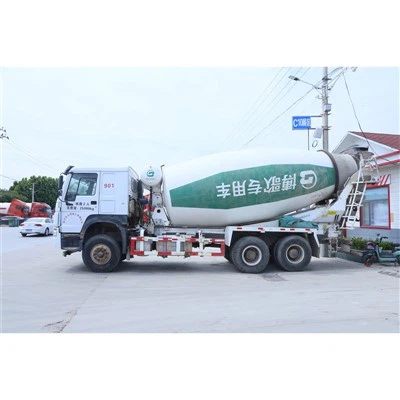
A concrete mixer (also cement mixer) is a device that homogeneously combines cement, aggregate (e.g. sand or gravel), and water to form concrete. They carry ready-mixed concrete to building or construction sites. The mixer truck features a mixing drum and specialised mixing mechanisms, concrete is mixed inside the rotating drum. For smaller volume works, portable concrete mixers are often used so that the concrete can be made at the construction site, giving the workers ample time to use the concrete before it hardens.
Features of Cement Mixer Truck
Our concrete mixer truck adopts an upgraded four-speed transmission control system, which increases the transmission efficiency to over 97.47%, making it smoother when transporting concrete.
These trucks are equipped with thick anti-skid tires to develop driving anti-skid function and provide assistive control during the starting phase of the truck on a hill.
These trucks adopt an integrated thermal management configuration, which allows their wearing parts to maintain a stable temperature and ensure that thermal energy consumption is reduced by more than 30% compared with ordinary concrete mixer trucks.
Our mixer trucks can quickly change the direction of rotation of the tank, preventing concrete from solidifying. Their blades all adopt a DC bed structure to ensure fast discharge speed and prevent cement residue from sticking to the tank.
Types of Cement Mixer Truck
Standard Transit Concrete Truck
This is one of the most popular models that can be seen on the market for concrete trucks for sale. The standard transit concrete truck is a special concrete making vehicle that is generally used for construction projects and other jobs where large amount of concrete is needed. You can find different transit concrete trucks on the market, with capacity ranging from 2 to 8 cubic meters of concrete output.
Rough Terrain Concrete Trucks
As the name suggest, the rough terrain concrete trucks are special concrete making machines which can driven over the most difficult terrains. A typical rough terrain concrete truck is a 4×4 wheel self-loading truck that can mix, load, and discharge more than 100 cubic meters of concrete per day. Most rough terrain concrete trucks are designed with weight-batching electronic equipment that ensures efficient concrete mixing process, and a slewing drum which allows the operators to discharge the concrete from every side of the truck. Ideal concrete making machine for both remote construction sites and urban city areas.


Volumetric Concrete Truck
This truck offers more advantages than the traditional machines for making and mixing concrete. It is a combination of a concrete batching plant and a mobile concrete mixer. All ingredients are stored in separate chambers, and the volumetric concrete truck has a unique mechanism which mixes all raw materials when concrete needs to be made. This is a big plus because the waste material is significantly reduced. The operators of this concrete truck can estimate the quantity of concrete that is needed, and the customers only pay for the amount they use on the construction site.
Mobile Volumetric Concrete Batching Plant
Like the standard volumetric concrete mixers, the mobile concrete batching plant also comes with separate compartments for all concrete ingredients, cement hopper, additive tanks, and a water tank. Since it is mobile, the operator can produce the quantity that is needed and in the same time to transport the concrete to the site where it is needed. When the operator starts the machine, all ingredients enter the mixing chamber in the required dose, and concrete comes out continuously, ready to be used.
Components of Cement Mixer Truck
Pedestal Components
The Hydraulic System
Pouring cement mix out of a cement truck. The hydraulic system is one of the most crucial components of a cement truck's pedestal. It controls the movement of the pedestal, including raising and lowering it. The hydraulic system uses high-pressure liquid to generate force and move different parts of the truck's mechanism.
Without it, it would be impossible to operate a cement truck. Most modern cement trucks use hydraulic systems lasting up to 10 years before needing replacement or repair.
The Bearings
Another critical component of a cement truck's pedestal is its bearings which allow smooth drum rotation. Bearings are small metal balls or rollers placed inside races or rings on both sides of an object that rotates around an axis like a wheel or drum.
In cement trucks' case, bearings sit at both ends of the drum axle and support its weight while allowing it to rotate freely in either direction during transportation or mixing operations. Without well-maintained bearings, cement trucks' drums may not turn as efficiently as they should during operation, leading to uneven mixing results.
The Support Legs
The support legs are integral parts located on either side under each end corner at the rear end frame opposite each other from where operators control them hydraulically from inside near the cab area with support leg control switches. They stabilize the truck during operation by allowing it to remain stationary when parked or loading and unloading. Support legs also provide additional stability for the entire truck when it's in mixing mode, making it less susceptible to tipping over or falling during uneven terrain usage.
Most support legs are fitted with sensors that detect any slight movement or shift in the truck's weight distribution, alerting drivers to take appropriate action quickly. However, like all other components of a cement truck, support legs require proper maintenance and care.
Drum Components
The Mix-Master
The blades inside the cement drum are the heart of every cement truck. These blades rotate at high speed, ensuring that all the components in the drum are mixed thoroughly.
Typically, two types of blades are used in cement mixers: spiral blades and paddles. Spiral blades mix the ingredients by pushing them toward the center of the mixer while paddles lift and drop them repeatedly.
Each blade is designed to have a unique shape that helps it function efficiently, ensuring optimal mixing. Some high-end cement trucks even come with adjustable blade configurations to ensure perfect mixing for different types of construction materials.
Water Tank
Two cement trucks lined up, ready to pour. Water is essential in mixing cement; without it, you can't create concrete. Every cement truck has a water tank where water is stored and transported to construction sites for mixing with cement. The tank sits above or below the mixer drum and typically holds 400-800 gallons of water.
The water tank is designed to be durable and withstand harsh environments since it's constantly exposed to weather elements such as rain or hot sun rays during transportation or operation. A good quality valve ensures water flows smoothly when needed, preventing leaks and wastage.
Chute
Once mixed, concrete needs to be dispensed at construction sites—where chutes come into play—they act as channels through which concrete flows out from the mixer onto a designated spot on site.
Chutes vary in size depending on their intended use; some are narrow, while others are wide enough to quickly dispense larger concrete volumes. Quality chutes are made from durable materials such as stainless steel or aluminum alloy, making them long-lasting despite frequent use.
One critical aspect of chutes is cleaning- keeping them clean ensures the concrete flows smoothly without blockages. It's crucial to clean the chute after every use, removing any remaining concrete before it dries, which may cause blockages later.
Chassis Components
The Engine
Cement truck near site containing sand. The engine is a crucial component of any vehicle, and cement trucks are no exception. It powers the hydraulic system that controls the movement of the pedestal and drives the truck to transportation sites. The engine used in cement trucks must be powerful enough to handle heavy loads of cement without compromising performance.
When selecting an engine for a cement truck, manufacturers consider factors such as torque output, fuel consumption rate, and emissions control. Modern engines used in cement trucks are designed to be more environmentally friendly while maintaining high-performance levels.
The Transmission System
The transmission system transfers power from the engine to the wheels and controls speed. Cement trucks require robust transmission systems because of their heavy loads, which causes significant wear on these components.
The most common type of transmission system used in cement trucks is an automatic transmission with multiple gears, allowing for smooth shifting between gears while ensuring maximum power delivery to the wheels.
The Suspension System
The suspension system is responsible for absorbing shocks during transportation and providing a comfortable ride for drivers. Cement trucks require strong suspension systems because of heavy loads, causing significant wear on these components.
The suspension system used in a cement truck typically consists of springs or airbags that support the vehicle's weight and its load while reducing vibration during operation. Some newer models use hydraulic shocks instead of springs or airbags to provide better shock absorption qualities.
Factors to Consider When Choose Cement Mixer Truck

01.Value-for-Money Investment
02.Size of the Mixer
03.Power Supply
04.New or Second Hand
05.Easy to Start
Benefits of Cement Mixer Truck
Fresh Concrete For Your Jobsite
Having a concrete mixer on site means that the concrete you need will always be fresh when you need it, regardless of its intended application. A mobile mixer can be used for common applications including flowable fill, rapid setting concrete, pervious concrete, and wet and dry shotcrete.
With traditional batch plant concrete, time is needed to load and deliver the concrete to your site. This can cause the concrete to begin degrading and lose workability, making it a more difficult solution to work with. Materials are stored in separate bins, so a fresh mix is consistently delivered each time.
Cost-Effective
Renting a mobile concrete mixer provides you with full control over your concrete delivery. Your ability to pay for what you need provides you with great project savings.
For remotely located construction sites or when the batch plant cannot be installed on site, a mobile concrete mixer truck provides the solution. No longer are you waiting for a concrete truck to arrive with delays like traffic and heavy demand impacting its timing and quality.
Environmentally Friendly
Being able to mix the exact amount you need when you need it reduces the amount of concrete waste produced. This protects our environment and leads to cost savings since waste requires proper disposal.
Sometimes, it can be tricky to order the exact amount of concrete required for a project, which can lead to ordering more than necessary. With a mobile concrete mixer truck, you can simply make an additional amount that’s needed.
Flexible Concrete Delivery
Like any regular concrete plant, mobile concrete mixers can be customized to meet your worksite’s exact requirements. No matter when you need it day or night, your concrete can be available in no time at all!
Colours, admixtures, and water can be modified to each concrete batch without ever needing to worry if the concrete is too hot or over mixed. Available products in our trucks include sand, unshrinkable fill (ufill), controlled density backfill and medium and high strength concrete. Fibre and air additives and custom mix ratios are available upon request.
Maintenance of Cement Mixer Truck
Well-defined Process
For unloading and cleaning trucks each day, here are a couple of common checklist items for operating, including:
- Make sure your hydraulic system is operating properly.
- Make sure all remote controls are clean at the end of each shift.
- Hose down the back of the truck and chute prior to unloading.
- Creating wind rows (for extra product).
- The video below is a great overview of this process if you are looking into revamping your current pre or post-trip inspection process.
Use a Concrete Dissolver
This product is biodegradable and is an acid-free solution to soften cement that can be rinsed off. This product you essentially apply and let sit for 15 minutes, and will begin to slowly soften. You can then take a brush to begin removing the excess concrete from your trucks. This stuff comes in a plastic tank with a foam sprayer and works best on concrete that isn't older. Check out this video to learn more.
Have a Process for Rinsing off Your Chute Correctly on-Site
You'll want to make sure you have a documented process for how to do this, including where exactly to rinse off on the job site your team is at.
Many jurisdictions levy penalties for contaminating storm drains, so you will want to ensure drivers follow the proper procedures each and every time they rinse the chute.
Attend Concrete Mixer Truck Maintenance Classes
One of the best ways to familiarize your leaders with proper maintenance for your fleet of trucks is to have service technicians attend concrete truck mixer maintenance classes, including the following:
Safety
- Electrical components
- Hydraulics
- Drum and chute
- Control systems
Consider a Washout System
With cutoffs at ground level controlling the hopper, collector, and drum nozzles, this ensures you clean the entire collector, drip ring, chute, and drum. So long as you maintain this type of system and dispose of washout properly, it's a good step to add to your process to ensure your trucks stay clean and maintained. If considering a new fleet of mixer trucks, this is one of those features that can make things a bit easier for drivers during post-trip inspections, and get your drivers back on the road a bit faster.
Perform Faster, Easier Inspections
One of the common pitfalls associated with vehicle inspections is the lack of data produced and acted on.
This also ensures the data collected can be used and acted on, which is especially useful when used to create preventative maintenance schedules and keep track of maintenance within the platform's fleet maintenance solution. Imagine how much more efficient and safe your fleet would be if the daily inspection items your team is already performing–like a washout process–could be digitally verified as complete each day?
Certificate Photo

Factory Photo
