

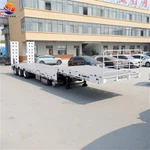


Container Semi Trailer
Shandong Jutong: Your Premium Cement Mixer Truck
Supplie
Shandong Jutong Special Vehicle Co., Ltd. is a professional semi-trailer manufacturer and used truck export supplier. Our company is located in Liangshan County, Shandong Province, China, which is known as a semi-trailer manufacturing base. At present, the company has more than 1,000 employees, including 670 senior professional and technical personnel and 32 professional technical personnel. Our workshop covers an area of over 1.5 million square meters, with main products of semi-trailers, trucks and trailers, dump trailers, dump trucks, etc., which are exported to Russia, the Middle East, Australia, Central Asia, Southeast Asia, Africa and other places.
Rich Experienced
Our team has been engaged in semi-trailer manufacturing for more than 20 years and has independent design, production and quality inspection capabilities. At present, our company has become a professional vehicle manufacturer recognized by the Ministry of Industry and Information Technology.
Well Equipped
Our company has more than 118 pieces of advanced equipment, including CNC cutting machines, automatic welding machines, WADF, X-ray detectors, four-wheel alignment devices, etc., with an annual output of more than 4,000 trailers, supporting large quantity orders.
Quality Assurance
Our products all undergo strict inspection procedures such as impact resistance, strength and appearance inspection after production, and have obtained certificates such as ISO, CCC and compulsory product certification.
Customized Services
Our team is online around the clock to promptly respond to your product inquiries, designs, and OEM and ODM order requirements, and provide customization services for product materials, appearance, and different components.


A container semi-trailer is a type of semi-trailer that can transport containers and non-hazardous goods. It is also known as a container chassis, intermodal chassis, or skeletal trailer. It is mainly used in ships, ports, route, highway, transit stations, bridges, tunnels, supporting intermodal logistics system, and are thus a key part of the intermodal supply chain. Like other intermodal equipment, it is equipped with twistlocks at each corner which allows a container (hoisted onto or off the chassis by a crane), to be locked on for secure transport or unlocked to be lifted off.
Features of Container Semi Trailer
Our container semi-trailers are equipped with landing gear to support it when uncoupled. Their wheels can be quickly and completely removed or repositioned to better distribute the load to the load-carrying wheels, ensuring smoother transport.
These semi-trailers feature a stable cargo platform that can handle larger loads, including extended containers, making them ideal for hauling long materials like pipes and lumber.
Our semis all have an average fuel efficiency of 6-8 miles per gallon and a range of 900 to 2,000 miles on a diesel tank, making them ideal for long-distance hauling missions.
The frames of these semi-trailers are made of strong steel, providing enough strength to support multiple beams, including main beams, support beams, and connecting beams. Their side beams are usually made from bent pieces of channel steel to add strength to the trailer.
Types of Container Semi Traile
Shipping Container Chassis The container chassis trailer is a basic structure that can be used to load 10ft, 20ft, and 40ft containers. Container chassis trailers are available in 20ft, 40ft, 45ft, 2 axles, 3 axles, and 4 axles. The most commonly used is the 3 axle 40ft container chassis trailer.
ISO Tank Container Trailer ISO tank container trailer is mainly used to transport iso tank container. 20Ft ISO tank container chassis, also named ISO tank chassis trailer. Generally used for transporting ISO containers in ports, shipyards, routes, bridges, tunnels, and transfer stations, supporting multimodal transport logistics syste
Extended Container Trailer As the name suggests, the length of the extended container chassis is variable, the benefit of this is that whether it's a 10ft, 20ft, 40ft container, the extended container chassis can be perfectly transported, it's extendable from the rear, and when the extended container. It is extendable from the rear and when the extended container chassis is contracted, it is as short as the normal model.
Place the load at the center of the trailer floor to maintain balance. Filling the floor lengthwise makes loading simpler. Although longer trailers can cause city traffic issues, they provide versatile solutions for transporting various types of cargo.
Gooseneck Container Chassis The Gooseneck container chassis is a robust framework that includes various components:
The frame assembly, suspension and braking systems, electrical setup, and travel mechanisms.
The frame itself has a gooseneck section, which links the mounting area to the carrying section. When the chassis is placed flat, the height of the carrying section is at min 1,350mm from the ground. This section features two crossbeam assemblies, spaced 11,989mm apart.
Each assembly also has two locking devices with a width distance of 2,260mm between them.
Flatbed Container Trailer A 40-foot flatbed trailer is typically designed to carry 20 or 40-foot containers. These trailers are essential for a seamless transport chain, connecting ships, ports, highways, transit stations, bridges, tunnels, and even multimodal transport systems.
The loading area of the flatbed is tailored to fit standard container sizes. To secure the container, twist-lock devices are strategically placed at each of its four bottom corners.
Container Side Loader A sideloader, also known as a sidelifter or self-loading trailer, is a specialized vehicle equipped with dual hydraulic cranes for lifting and transporting containers. Operated by the driver through on-site controls or a remote, this versatile machine is a cornerstone in modern logistics, linking trucks, trains, and ground-level operations.
It's design allows for efficient container handling even in tight spaces, opening up new business opportunities in an ever-changing market. With minimal manpower and no need for additional equipment, a sideloader streamlines the entire transport process, enhancing both speed and competitiveness.
Container Tilt/Tipping Trailers The container tipping trailer offers a unique structure to streamline the loading and unloading process. Consisting of upper and lower frames connected by a pivot device, this trailer is ideal for operations where a crane isn’t available. A hydraulic cylinder elevates the upper platform, simplifying the loading procedure.
During offloading, the trailer tilts backward, allowing gravity to guide the container gently onto the ground. Once the container’s rear end makes contact, the truck moves forward, letting the container continue its descent.
In essence, a container tipping trailer functions similarly to a traditional tipper trailer, but without the tipping bucket, offering a practical and efficient solution for container transport.
Factors to Consider When transport Container

Container Certification
You should know that shipping containers come with a Container Safety Convention (CSC) plate. A shipping container cannot legally travel without one. A CSC Plate is only granted after a shipping container has been duly inspected by experts. Every single shipping container must first be confirmed safe for travel before the granting of a CSC plate. The CSC place is also referred to as the Safety Approval Plate.
Container Size
You need to choose the best shipping container that can fit your goods because picking one of the wrong size will require you to have two or more shipping runs. That would add to your costs and you won't want that.
The most common shipping container sizes are 20 ft. and 40 ft. If you need to ship your container overseas, then you need to choose ones that follow internationally agreed standard sizes for easy transport from one port to the next.

Container Packing
Planning everything to a T will be futile if your goods won't be packed properly. You need to ensure that you'd get to work with trained packing experts. Be aware of the needs of your goods. Should you need to transfer medicine, you should secure boxes that have temperature control features. Containers with doors are best if you'd be moving your container from one port to another. A container with doors will require the need for people to fully unload everything. They could simply open a dedicated door and directly access goods that are to be unloaded.
Transportation Vehicle
You also need to consider the vehicles you would use for road transport. You will need trucks as they will serve as links that allow for smooth sea travel. Choose high-powered trucks that can handle the nature and weight of your shipping container and goods. If you want a truck that can quickly load and unload your shipping container, look for a container tilt trailer. You can opt for a container side trailer if you want to use lift modules or cranes for loading and unloading your shipping container.

Benefits of Container Semi Trailer
Versatility
The lifting capacity of the loader is comparable to that of a 100-120 ton m crane, which speaks volumes for the level of performance it can deliver. Low ground pressure makes the truck more suitable for rough terrain, and the low operating altitude makes it less susceptible to the weather. In times of economic crisis, the load is often the last unit standing still.
Minimised Need for Extra Equipment
Nowadays, loading trailers are equipped with outriggers and integrated cranes, allowing a single driver to load containers in minutes. However, traditional vehicles still require additional equipment to secure and safely transport goods. With forklifts, you reduce costs and eliminate other handling equipment, including warehouse trailers and trolleys, pallet jacks and forklifts. Instead, your delivery can get there quickly.
Minimal Labour Costs
Our loader trailers are particularly well suited for container handling and delivery due to their integration - their trailers have built-in cranes and cranes that allow them to load or unload a container of goods safely in a few minutes. In addition, the process is largely automated and requires very little labour or human supervision. As a result, sidelifter shipping can significantly reduce labour costs that would otherwise cost workers to unload your delivered containers manually.
Faster Turn Around
These trailers make it possible to quickly load and unload containers whenever and wherever you want. The total run time is 2-4 minutes, and the rider can move on to the next task. Minimising wait times means greater efficiency and opportunities to increase container throughput. That's why vendors and suppliers using side loaders are becoming more and more popular with customers.
What You Should Know When Use Container Semi Trailer
Check Tires
By simply checking tires on a regular basis, you may avoid a major expense or an unsafe situation on the road. As a driver, you should check tires before every trip to ensure there is no damage or leaks. Additional checks include checking tire wear, any pressure monitoring or inflating systems, and any components that could affect tires such as:
- Suspension
- Shock absorbers
- Undercarriage
- Axles
Check Lights
Part of safe highway travel is making sure that all lights are functioning on your trailer. Whether you're traveling in the daytime or at night, trailer lights tell other drivers when you're changing lanes, braking, hazard lights, and illuminate the roadway. Since lights are highly visible, they may be a common target for violations, adding to the reasons for checking them regularly. Here are a few things to look for:
- Wiring
- Clear lenses
- Broken lenses or lights
- Corrosion
Keep Trailer Lubricated
Trailers have numerous parts that need to be lubed for proper functioning and to help prevent issues like corrosion, especially in the winter when parts can get locked up. Without regular maintenance and lube, you could end up with more frequent and costly semi-trailer repairs. More specifically, check around the:
- Kingpin
- 5th wheel pivot and plates
- Main rail
- Drag link
- Check for missing hardware like bolts
Check Security Mechanisms
Semi-trailers feature a number of mechanisms to help secure freight, doors, and other potentially loose components during transit. If a tie-down or chain is broken or damaged, it could lead to broken freight or unsafe conditions. Inspect the following semi-trailer parts for tears, holes, snags, corrosion, or other damage regularly:
- Tie downs
- Ratchets
- Door locks and handles
- Straps
- Winches
Clean The Semi-trailer
Taking time every four to six weeks to clean the trailer also gives you the opportunity to conduct a visual inspection, which may reveal other issues you weren't aware of. It's also a good time to remove any debris that's caught in trailer components.
Check Brakes
Of course, brakes vary depending on the type of trailer and freight being hauled, so inspection intervals may vary. Additionally, if your trailer travels through heavy winter conditions, the brakes could be affected by de-icing chemicals.
Certificate Photo

Factory Photo
