

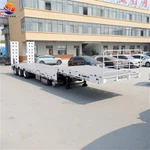


Dump Trailer
Shandong Jutong: Your Premium Cement Mixer Truck
Supplie
Shandong Jutong Special Vehicle Co., Ltd. is a professional semi-trailer manufacturer and used truck export supplier. Our company is located in Liangshan County, Shandong Province, China, which is known as a semi-trailer manufacturing base. At present, the company has more than 1,000 employees, including 670 senior professional and technical personnel and 32 professional technical personnel. Our workshop covers an area of over 1.5 million square meters, with main products of semi-trailers, trucks and trailers, dump trailers, dump trucks, etc., which are exported to Russia, the Middle East, Australia, Central Asia, Southeast Asia, Africa and other places.
Rich Experienced
Our team has been engaged in semi-trailer manufacturing for more than 20 years and has independent design, production and quality inspection capabilities. At present, our company has become a professional vehicle manufacturer recognized by the Ministry of Industry and Information Technology.
Well Equipped
Our company has more than 118 pieces of advanced equipment, including CNC cutting machines, automatic welding machines, WADF, X-ray detectors, four-wheel alignment devices, etc., with an annual output of more than 4,000 trailers, supporting large quantity orders.
Quality Assurance
Our products all undergo strict inspection procedures such as impact resistance, strength and appearance inspection after production, and have obtained certificates such as ISO, CCC and compulsory product certification.
Customized Services
Our team is online around the clock to promptly respond to your product inquiries, designs, and OEM and ODM order requirements, and provide customization services for product materials, appearance, and different components.


A dump trailer is a type of trailer with an open box bed and the ability to lift the front of that bed to dump the materials out easily. Smaller trailers can maneuver tight spaces, while larger trailers can carry large-capacity loads like mulch or trash. Larger trailers are best for carrying heavy and tough materials like soil, gravel, sand, and metals.They can help you with anything from heavy hauling, demolition, site preparation, mining, agriculture, construction, environmental cleanup, excavation, grading, and disaster management.
Features of Dump Trailer
Large Dumping Angle
Our dump trailers release loads faster from straight sides and ensure less material sticks in the bucket because of their wider 50° dump angle, which is nearly 10° greater than other available side roll angles !
Durable Accessories
They feature synthetic grease-filled hubs and virtually eliminate wheel seal failures to reduce downtime from breakdowns. These hub caps also protect your spindle and bearings from debris and damage on the job.
Sturdy Structure
The frames of these trailers are made from tub material, and their support locations are reinforced to give them a lighter frame and suspension capabilities while bend and twist without cracking.
Low Maintenance
Our trailer's bolt-on parts are easier and less expensive to maintain, adjust and replace than welded parts. You can repair parts on site without taking the trailer to a shop and avoiding any welding, sanding or painting.
Types of Dump Trailer
End Dump Trailers End dump trailers have been the most common dump trailers for many years. End dump trailers are named after their loading method. The front of the box is pushed up into the air via hydraulics allowing the materials to fall out of the back gate. Most commercial end dumps range in length from 26 to 40 ft and is commonly tandem or tridem axle configurations. End dumps are commonly used in construction (specifically road and building construction), as well as in the agriculture industry and aggregate stockpiling fields.
Side Dump Trailers Side dumps are named after their unloading capabilities. Using hydraulic rams, side dumps unload the cargo off the right or left side of the trailer and can do so without requiring the air ride suspension to be deflated beforehand. Side dumps are heavily used in the construction and waste disposal industries and are used when building roads, pit mining, excavating, transporting semi-liquids, performing stockpile dumps and moving fine materials.
Belly Dump Trailers Unlike other dump trailers, belly dump trailers (also known as bottom dump trailers and cross gate trailers) have gates at the bottom of the trailer that open up like a clam shell. While driving at a variety of speeds, these trailers allow the material to drop through the bottom gates in a windrow – a long line of material versus a pile. These trailers are ideally suited to road maintenance that required gravel or asphalt to be spread evenly across large areas. Belly dumps are commonly used in stockpiling and material transport, but they're particularly good at gravelling roads. These trailers are ideally suited to road maintenance.
Live Bottom Trailers Live bottom and belt floor trailers are among the newest of dump trailers on the market. Their unique belt floor allows the material to be dumped out the back of the trailer more precisely that other dump trailers. They generally lead to safer dumps, reduced chance of rollover, and are gentle on your payload. You'll find Live Bottom trailers in use in a variety of industries including road construction, aggregate hauling and agriculture.
Factors to Consider When Choose Dump Trailer
Weight Capacity
Selecting the appropriate weight capacity for your dump trailer is vital for two reasons. Firstly, overloading can cause damage to both the trailer and the towing vehicle, leading to costly repairs. Secondly, having a dump trailer with a high weight capacity when you only need to transport small loads is an unnecessary expense. Conversely, having a low weight capacity when regularly hauling heavy machinery or materials will pose a significant risk. Always match the weight capacity of your dump trailer to your intended use to ensure safe and efficient transport.
Trailer Size
When selecting a dump trailer, it is crucial to consider the size based on the volume of materials or items you intend to haul. If you frequently transport large loads, opting for a larger trailer will ensure it meets your needs. Conversely, if you only sporadically transport small quantities, a smaller trailer will suffice, saving you unnecessary expenses. Take note of the dimensions of the trailer bed to guarantee that it offers enough space for your intended purposes.
Trailer Material
When choosing a dump trailer, the material it is made from is an important factor to consider. Steel trailers are known for their durability and are ideal for heavy-duty applications. They can handle rough terrain and withstand substantial loads. On the other hand, aluminum trailers are lightweight and corrosion-resistant, making them a good choice for those seeking a more portable and low-maintenance option. Consider your specific needs, the type of use, and your budget when deciding between steel and aluminum trailers.
Dumping Mechanism
The dumping mechanism of a dump trailer is an important consideration. Hydraulic dump trailers offer convenience and efficiency as they can be easily operated with the push of a button. This allows for quick and effortless dumping of materials. On the other hand, manual dump trailers require physical effort to operate, typically using a hand crank or lever. While manual dump trailers may be less expensive, they require more labor and time to dump the load.
Consider your specific needs and budget when deciding between a hydraulic or manual dumping mechanism. A hydraulic dump trailer may be the better choice if you value convenience and time-saving. However, a manual dump trailer can still get the job done effectively if you have a limited budget or don’t mind the extra physical effort.
Trailer Brakes
Trailer brakes become a non-negotiable safety feature on your dump trailer when dealing with heavy loads. Equipped with brakes, your trailer ensures enhanced control and stopping power. This becomes particularly beneficial when navigating downhill terrains or encountering unexpected stops.
Choosing a dump trailer with trustworthy and high-performing brakes is vital. It significantly elevates the safety level of your towing activities, offering you peace of mind and assurance in various towing situations.
Price and Budget
Finally, consider your budget when buying a dump trailer. These trailers come in a wide range of prices, depending on their size, capacity, and features. It's important to determine your budget beforehand and find a trailer that meets your needs without exceeding your financial limitations. Remember to consider the long-term value of the trailer as well, as investing in a higher-quality trailer may save you money on repairs and replacements down the line.
What You Should Know When Use Dump Trailer
Brakes are essential to the trailer's functionality and the operator's safety. It would be best if you inspected the brake shoes and drums at least once per year or every 12,000 miles, whichever comes first. The shoes require more frequent inspections, however, every 3,000 miles.
You must assess the fasteners and frame members at least once per year. Look for signs of twisting or bending. Also, inspect each member for cracks or failures. Significant frame damage is more likely if you abuse the trailer, using it to transport beyond its capacity.
The lights and signals on the trailer are for your safety and the safety of other drivers. Before you tow your custom trailers anywhere, test that all electrical connections are working. You want to test the brake lights and the turn signals. A failure of these components can cause an accident on the road.
Wheel bearings can become loose. If the bearings on your trailer are loose, you may experience grabbing brakes. The jerky sensation points to a bearing issue. To service the bearings, you need an adequate trailer jack. Check the wheels. If the wheels are wobbly, there is likely a bearings issue, and the trailer will need to be serviced.
Wheels are susceptible to damage. Many people trying to maneuver trailers hit curbs or other vehicles, especially when unfamiliar with them. It is crucial to check the wheels after a collision to ensure they are still intact and safe for operation. Even if you do not experience an accident, you should check your wheels at least once per year.
Certificate Photo

Factory Photo
