

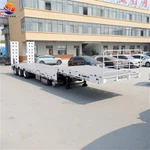


Extendable Pole Trailer
Extendable pole trailers are engineered for transporting utility poles, timber, steel pipes, and other linear cargo that require variable frame lengths, distributed support points, and secure load restraint. The trailer structure can be adjusted to match specific cargo dimensions, payload ratings, axle capacities, braking systems, and destination-market compliance.
Key Technical Specifications
|
Item |
Configuration |
|
Trailer Type |
Extendable Pole Trailer |
|
Primary Application |
Utility poles, timber, steel poles, and oversized linear cargo |
|
Length Configuration |
Retracted and extended mechanical adjustment options |
|
Payload Capacity |
Configured according to axle ratings, frame structure, and regional road laws |
|
Axle Configuration |
Single-axle, tandem-axle, or project-specific multi-axle arrangements |
|
Suspension |
Mechanical spring suspension or air suspension configurations |
|
Braking System |
Electric, air, or market-specific compliant braking systems |
|
Hitch Interface |
Adjustable hitch plate, pintle eye, or towing eye configurations |
|
Pole Support |
Front, center, and rear bolster arrangements with adjustable stanchions |
|
Load Restraint |
Heavy-duty ratchet binders, nylon straps, and integrated tie-down points |
|
Surface Treatment |
Industrial paint systems or hot-dip galvanized components |
|
Electrical System |
Multi-voltage road lighting and wiring configured for target markets |
Axles, Suspension, and Braking Systems
Under-running gear selection directly impacts towing stability, legal payload limits, and stopping distances.
Axle Capacity: Heavy-duty commercial axles matched to target gross vehicle weight ratings.
Suspension Options: Robust multi-leaf mechanical springs or air ride configurations suited to job-site conditions.
Brake Compliance: Integrated braking systems engineered to meet regional safety regulations, including automatic slack adjusters and ABS compatibility where required.
Wheel and Tire Assemblies: Commercial-grade radial tires mounted on heavy-duty steel disc wheels.
Typical Applications
Utility & Power Distribution: Transporting wood, steel, or composite utility poles directly to line-construction sites.
Telecommunications Infrastructure: Hauling communication poles and long structural components for network expansion.
Timber & Forestry: Carrying long timber logs and specialized forestry products where permitted by local axle laws.
Infrastructure Construction: Moving long steel beams, piles, and concrete pillars that exceed standard flatbed capabilities.
Extendable Frame Structure
The extendable center section allows operators to alter the usable trailer length based on specific transport runs. Retracting the frame minimizes overall vehicle length during empty returns or shorter cargo hauls, while extending it provides necessary clearance for oversized loads.
Structural Considerations
Telescopic Beams: Precision-aligned sliding inner and outer frame members.
Locking Mechanisms: Positive mechanical locking pins and secure positioning points.
Wear Pads & Guides: Low-friction sliding interfaces designed for frequent length adjustments.
Load Transfer: Reinforced connection zones ensuring structural continuity between fixed and moving sections.
Bolsters and Stanchion Systems
Support components dictate how securely linear cargo rides during transit. Bolsters carry the downward vertical weight, while stanchions prevent lateral shifting around corners.
Bolster Placement: Front, center, and rear bolster assemblies positioned to eliminate excessive cargo overhang.
Adjustable Stanchions: Removable or width-adjustable upright posts matching various pole diameters.
Support Cradles: Specialized surfaces designed to protect timber, steel, or concrete surfaces from impact damage.
Restraint Integration: Built-in winch binders and heavy-duty tie-down loops welded directly to the bolster frames.
Main Frame and Chassis Construction
The longitudinal frame absorbs both static payload weights and dynamic torsional forces encountered on uneven secondary roads.
Longitudinal Beams: High-strength structural steel sections with calculated wall thicknesses.
Crossmember Spacing: Engineered intervals providing transverse rigidity without adding unnecessary tare weight.
Reinforced Stress Points: Gusseted joints around suspension hangers, hitch mounts, and bolster interfaces.
Component Balance: Synchronized engineering ensuring frame capacity, axle ratings, and hitch structures match harmoniously.
Step-by-Step Selection Guide
Define Cargo Dimensions
Provide the minimum, typical, and maximum lengths of the poles or linear cargo, along with individual and combined weight figures.
Establish Payload Requirements
Calculate the maximum expected payload weight to determine appropriate axle ratings and frame reinforcement levels.
Match the Towing Vehicle
Verify tractor fifth-wheel or pintle hook capacities, brake connections, electrical plug types, and rear axle load limits.
Confirm Regional Regulations
Identify local highway laws governing overall vehicle length, maximum width, rear overhang limits, lighting, and braking compliance.
Manufacturing, Fabrication, and Inspection
Structural integrity relies on precise material preparation, controlled welding processes, and dimensional verification.
Plate Preparation: CNC cutting and CNC plasma cutting machinery ensuring accurate component profiling.
Welding Standards: Automatic welding processes applied to primary load-bearing longitudinal seams.
Dimensional Control: Laser and mechanical alignment checks applied to extendable frame sections and axle mounts.
Quality Verification: Rigorous structural inspections, weld testing protocols, and final dimensional audits prior to dispatch.
Surface Treatment and Corrosion Protection
Pole trailers frequently operate in outdoor environments exposed to moisture, road salt, mud, and abrasive job-site debris.
Surface Preparation: Comprehensive abrasive blast cleaning removing mill scale and impurities.
Coating Application: Multi-layer industrial priming and specialized topcoats designed for extended outdoor durability.
Galvanization Options: Hot-dip galvanized treatments available for specific structural sub-components or full-frame configurations upon request.
Maintenance and Operational Guidelines
Pre-Trip Inspection Checklist
Operators should verify several critical points before every transport run:
• Extendable Section Locks: Ensure mechanical locking pins are fully engaged and secured.
• Sliding Track Surfaces: Check wear pads and guide channels for cleanliness and proper lubrication.
• Load Restraints: Inspect ratchet binders, nylon straps, and tie-down loops for wear or damage.
• Braking and Electrical Systems: Test emergency breakaway systems, lighting functionality, and air or electric brake responses.
• Tire Pressure and Condition: Confirm commercial tires meet pressure requirements and show no abnormal tread wear.
Routine Servicing Intervals
• Weekly Maintenance: Lubricate sliding frame wear surfaces, pivot points, and hitch interfaces with high-temperature grease.
• Monthly Checks: Inspect main frame welds, bolster mounting bolts, suspension leaf springs, and axle alignment.
• Quarterly Service: Check brake lining thickness, slack adjuster operation, electrical wiring integrity, and structural pin wear.
FAQ
Q: What is the maximum extended length available for this pole trailer?
A: The available length range is configured based on project requirements and regional highway regulations. Sliding frame structures are engineered to specific retracted and extended dimensions to accommodate the exact maximum cargo length provided during the initial engineering review.
Q: How does the trailer maintain structural integrity when fully extended?
A: Structural strength is maintained through reinforced telescopic beam sections, precision-fitted sliding receiver channels, and positive mechanical locking mechanisms. Load transfer is calculated across the entire extended span to prevent excessive deflection under maximum payload conditions.
Q: Can the bolster spacing and stanchion positions be adjusted?
A: Bolster assemblies and stanchions can be positioned or adjusted to match varying pole lengths and diameters. Specific configurations are selected to ensure proper load distribution and prevent lateral shifting during transit.
Q: What brake systems are compatible with regional road regulations?
A: Braking configurations include electric brakes, air brake systems with automatic slack adjusters, and required ABS setups. Final specifications are matched directly to the safety and compliance standards of the destination country.
Q: What information is required to begin the engineering and quotation process?
A: Submitting the minimum and maximum cargo lengths, payload weights, cargo types, towing vehicle specifications, and destination country allows engineering teams to review configuration options and prepare an accurate commercial proposal.
Hot Tags: extendable pole trailer, China extendable pole trailer manufacturers, curtain side semi trailer, semi trailer components, semi trailer demand, semi trailer fleet, semi trailer industry, semi trailer innovation
Previous
Extendable Timber TrailerYou Might Also Like



Send Inquiry