

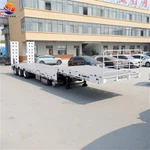


Extendable Semi Trailer
Your Professional Extendable Semi Trailer Supplier
We supply extendable semi trailers for long, oversized and project cargo that cannot be efficiently handled by a fixed-length trailer. The product range can be configured as extendable flatbed trailers, extendable lowbed trailers, telescopic deck trailers and specialized trailers for wind turbine blade and other long-component transportation.
Depending on the cargo and operating conditions, the trailer can be specified by extended deck length, payload, axle configuration, suspension, steering system, deck height, kingpin position, braking system and other technical requirements.
The right configuration starts with the cargo dimensions, cargo weight and transport route-not simply the trailer length.


Key Specifications for Procurement
|
Specification |
Typical Selection Consideration |
|
Trailer Type |
Extendable flatbed, lowbed, telescopic or specialized configuration |
|
Cargo Length |
Confirm minimum and maximum cargo length |
|
Extended Length |
Determined by cargo dimensions and route requirements |
|
Payload |
Based on cargo weight and axle distribution |
|
Axles |
2, 3, 4 or multi-axle configurations depending on application |
|
Suspension |
Mechanical or air suspension according to operating conditions |
|
Steering |
Fixed, self-steering or hydraulic steering depending on trailer configuration |
|
Deck Width |
Selected according to cargo dimensions and legal road limits |
|
Deck Height |
Important for overall transport height and clearance |
|
Main Beam |
High-strength structural steel selected according to loading requirements |
|
Kingpin |
Selected to match the tractor and local market requirements |
|
Brake System |
Air brake configuration with ABS/EBS options where required |
|
Tires |
Size and load rating matched to axle and operating requirements |
|
Lighting |
24 V electrical system or market-specific configuration |
|
Cargo Securing |
Lashing points and other securing equipment according to cargo |
|
Extension System |
Mechanical or hydraulic configuration depending on trailer design |
Why Choose Us
Advanced Manufacturing Facilities
Production processes rely on heavy-duty industrial machinery, including precision CNC cutting systems, automated welding equipment, and specialized plasma cutting lines, ensuring consistent weld penetration and structural uniformity across every chassis component.
Rigorous Quality Verification and Testing
Quality assurance protocols incorporate rigorous inspection procedures, including non-destructive X-ray examination for critical structural welds, comprehensive braking performance trials, and precise multi-axle wheel alignment checks before delivery.
Global Drivetrain and Component Compatibility
To ensure long-term operational reliability and simplified maintenance abroad, our trailers integrate globally recognized, heavy-duty components such as dependable axle assemblies, pneumatic braking circuits, and robust landing gear systems compatible with standard international tractor configurations.
Typical Applications
Wind Turbine Components: Transporting long wind turbine blades and other wind power components where conventional trailer deck length is insufficient.
Bridge and Infrastructure Components: Moving long bridge girders, structural steel sections, precast concrete components and other infrastructure materials requiring an extended loading platform.
Steel and Pipe Transportation: Supporting long steel profiles, pipes and fabricated structures along a greater deck length, reducing the need to concentrate cargo on a shorter loading area.
Construction and Industrial Equipment: Transporting large industrial components and oversized equipment with customized deck length, payload and axle arrangements.
Project Cargo Transportation: Specifying trailers for project-based transportation around actual cargo parameters rather than relying on standard flatbed configurations.

How an Extendable Semi Trailer Works
The basic concept is simple: the trailer incorporates an extendable structural section that increases the effective loading length when required.
In the retracted position, the trailer remains more compact for positioning, loading and transport without long cargo. When extended, the additional deck length provides support for cargo that would exceed the usable length of a conventional trailer.
The extension system must be considered together with:
Main beam structure and cross members
Extension section and mechanical locking points
Axle position and suspension geometry
Cargo securing points and lashing positions
Brake, electrical and steering configurations
For long and heavy cargo, extension length should not be considered separately from axle load distribution and structural loading.

How to Select the Right Extendable Semi Trailer
Cargo Length
Provide both the normal cargo length and the maximum cargo length. Review minimum cargo length, maximum cargo length, required support points and cargo overhang limitations. The required extended length should be based on actual cargo geometry and loading methods.
Cargo Weight
Payload should be calculated from the actual cargo weight and its center of gravity. A heavy cargo load does not automatically require the same trailer configuration as another load of identical weight because axle loads depend heavily on cargo position and weight distribution.
Axle Configuration
Axle quantity and rating influence payload distribution, road legality, ground pressure, trailer stability, turning characteristics and maintenance requirements. Configurations can be developed around different axle requirements and project conditions.
Extended Length
The required extension length should be determined from the maximum cargo dimensions. Longer does not necessarily mean better. Excessive trailer length can affect turning radius, route selection, axle distribution and local road compliance.
Deck Height and Width
For oversized cargo, deck height directly affects overall transport height. Deck width should also be checked against cargo width, loading equipment, road restrictions and required side clearance.
Steering Requirements
Long trailers may require additional steering solutions to improve maneuverability. For wind blade and other exceptionally long cargo applications, steering axle configurations can be considered according to the tractor, trailer length and route conditions.
Main Structure and Components
Main Beam: The main beam carries the primary bending and vertical loads generated by the cargo. Material thickness and beam geometry are selected according to payload, extension length and load distribution, utilizing high-strength structural steel construction.
Extension Section: The extension section is the key structural interface. Its design maintains adequate structural support and alignment when extended while allowing the trailer to return to a compact configuration safely.
Axles and Suspension: Axle quantity and suspension configuration are matched to the actual payload and road conditions, incorporating established heavy-duty axle assemblies.
Braking System: Brake configuration is selected according to the target market and tractor compatibility, featuring reliable air braking circuits and optional ABS/EBS integration.
Landing Gear and Kingpin: Landing gear safely supports the uncoupled trailer, while the heavy-duty kingpin specification matches standard tractor fifth-wheel couplings.

Customization Options
Extendable trailers are normally specified around specific cargo requirements rather than purchased as fixed configurations. Available engineering options include:
Overall and extended deck length dimensions
Payload rating and reinforcement
Number and rating of axle lines
Mechanical or air suspension setups
Self-steering or hydraulic steering axle systems
Custom deck width and low-profile deck height
Main beam cross-section and thickness
Kingpin size and fifth-wheel position
Brake system standards and ABS/EBS layout
Tire load ratings and dual/super-single wheels
Cargo lashing points, pockets and ramps
Landing gear and multi-voltage electrical configurations
For project cargo, engineering reviews analyze cargo drawings, dimensions, weight, center of gravity and transport routes before finalizing the trailer configuration.
Manufacturing and Quality Control
Extendable trailers place high demands on structural alignment and load distribution because the vehicle must perform reliably in both retracted and extended configurations.
Manufacturing operations integrate advanced production equipment to control quality across every critical manufacturing stage:
Material Preparation
Precision CNC cutting and plasma cutting machines.
Component Fabrication
Automatic welding equipment for consistent structural joints.
Assembly & Inspection
X-ray non-destructive testing for critical welds and precise wheel alignment equipment.
Final Verification
Structural dimension checks, braking performance tests and extension mechanism trials.
FAQ