

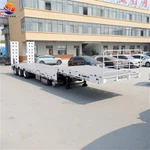


Heavy Haul Semi Trailer
Your Professional Heavy Haul Semi Trailer Supplier
We supply heavy haul semi trailers for transporting construction machinery, mining equipment, industrial machinery, and other heavy or oversized cargo. Our range covers low bed trailers, lowboy and gooseneck configurations, detachable gooseneck trailers, hydraulic tilt lowbeds, multi-axle heavy-duty lowbeds, widenable platforms, and hydraulic modular trailers.
Trailer dimensions, axle configuration, suspension, braking system, deck structure, and loading equipment can be configured according to cargo weight, dimensions, loading method, road conditions, and local transport requirements.


Product Specifications
|
Model / Series |
Rated Payload |
Overall Dimensions (L × W × H) |
Main Beam / Steel Material |
Axle Configuration & Capacity |
Suspension Type |
Braking & Electrical System |
|
HHT-3A30 |
30,000 kg |
13,000 mm × 3,000 mm × 850 mm |
Q460C / T700 High-Strength Steel |
3 axles × 13T / 16T (Fuwa / BPW) |
Mechanical leaf spring (Heavy duty) |
Dual-line pneumatic braking, WABCO ABS, 24V LED lighting |
|
HHT-4A50 |
50,000 kg |
13,500 mm × 3,000 mm × 900 mm |
Q690D High-Strength Low-Alloy Steel |
4 axles × 16T, optional self-steering |
Heavy-duty mechanical or Air suspension |
Emergency relay valve, optional EBS, ISO standard socket |
|
HHT-MA60 |
60,000 kg |
Customized × 3,000–3,400 mm (Widenable) |
HG60 / Q690 structural steel |
Multi-axle bogie or hydraulic steering axles |
Heavy mechanical walking beam / Hydraulic suspension |
Advanced pneumatic braking with multi-way protection valves |
|
HHT-MD100+ |
80,000T to 150,000T+ |
Modular platform dimensions upon request |
High-tensile structural box-section steel |
Modular multi-axle lines with hydraulic compensation |
Hydraulic cylinder suspension with all-wheel steering |
Dual-circuit braking system with fail-safe spring parking brake |
Why Choose Us
Engineering Tailored to Your Regulations:
We analyze your local axle-weight laws and bridge formulas before design, ensuring your trailers pass registration and compliance checks without hassle.
Rigorous Material Traceability
Every steel plate used in our heavy haul frames comes with certified mill test reports, guaranteeing absolute structural integrity under maximum payload.
End-to-End Technical Support
Our engineering team provides complete turning radius simulations, center of gravity analysis, and customized load distribution drawings for complex project cargo.
Proven Global Delivery Record
Trusted by heavy transport contractors worldwide, our trailers are structurally reinforced to endure aggressive tropical heat, sub-zero cold, and corrosive coastal operating environments.
Core Product Features
Extreme Load Distribution
Engineered with optimized kingpin-to-axle weight distribution to prevent localized structural fatigue and comply with strict legal bridge weight formulas.
Low Center of Gravity Deck
Features a lowered cargo platform designed to enhance stability during high-speed transit and allow safe clearance under low bridges and utility wires.
Versatile Loading Integration
Accommodates multiple front and rear loading methods including mechanical spring ramps, hydraulic folding ramps, and front-loading detachable goosenecks.
Robust Anti-Torsion Frame
Built with high-yield structural steel and reinforced cross-members to resist severe twisting forces experienced on unpaved mining tracks and rugged construction sites.
Payload and Axle Configuration
Heavy haul trailer capacity should not be evaluated only by the advertised payload. The practical configuration depends on:
Cargo weight
Trailer tare weight
Axle capacity
Number of axles
Axle spacing
Kingpin load
Suspension type
Cargo center of gravity
Local axle-load regulations
Road and bridge restrictions
Our current lowbed range includes 3-, 4-, and multi-axle configurations, with listed payload options ranging from approximately 30T to 100T on selected lowbed models. Higher axle-count configurations are available for heavier applications.

Heavy Haul Trailers for Different Cargo
Construction Machinery: Excavators, bulldozers, wheel loaders, rollers, and other construction equipment. (Typical choice: Low Bed / Lowboy / Detachable Gooseneck).
Mining Equipment: Heavy mining machinery and equipment requiring higher axle capacity. (Typical choice: Multi-Axle Heavy-Duty Lowbed).
Industrial Machinery: Large generators, industrial equipment, and project machinery. (Typical choice: Heavy-Duty Lowbed / Hydraulic Modular Trailer).
Oversized Machinery: Cargo exceeding standard trailer width or requiring special loading arrangements. (Typical choice: Widenable Lowbed / Customized Heavy Haul Trailer).
Energy & Project Cargo: Large industrial and energy components. (Typical choice: Multi-Axle or Hydraulic Modular configuration)

Standard Operating and Maintenance Guide
Hydraulic Ramp Operation
Pre-Check: Verify fluid levels, warm up the PTO/power pack, and inspect hoses for leaks.
Lowering: Clear the area and use control valves to lower ramps smoothly onto solid ground; avoid rapid dropping.
Transit Security: Retract ramps fully and engage mechanical safety locks or chains before driving. Never travel with systems pressurized.
Detachable Gooseneck Procedures
Preparation: Park on firm, level ground and disconnect all air, electrical, and hydraulic lines.
Unlocking: Lower the front deck/support base until weight is supported, then release safety locking pins.
Separation: Drive the tractor forward while operating hydraulics to lift/swing the gooseneck clear for front loading. Reverse steps to reconnect.
Multi-Axle Tire Management
Inflation: Maintain identical cold pressures across all tires in an axle group to combat scrubbing wear.
Dual Matching: Ensure paired tires have matching outer diameters to prevent load imbalance and overheating.
Checks: Monitor wheel hub and tire temperatures during long-distance stops to detect dragging brakes or overloads.
Periodic Lubrication Schedules
Daily / Pre-Trip: Grease high-friction pivot points, ramp hinges, kingpins, and suspension bearings.
Weekly: Lubricate brake camshafts, slack adjusters, and steering ball joints; check central grease blocks.
Monthly / Quarterly: Repack wheel bearings, inspect slewing rings, and clean grit from locking mechanisms before re-greasing.
How Heavy Haul Trailers Are Built and Inspected
For heavy-duty trailers, structural consistency is more important than cosmetic appearance. Our production capability includes CNC cutting, automatic welding equipment, plasma cutting, X-ray inspection, and four-wheel alignment equipment.
Relevant production and inspection stages include:
Steel preparation → CNC cutting → component forming → frame assembly → welding → axle/suspension installation → brake/electrical installation → alignment → surface treatment → final inspection.
Quality checks can include:
Dimensional inspection
Weld inspection
Structural inspection
Brake system inspection
Axle alignment
Surface inspection
Functional testing

Heavy Haul Trailer Configuration Options
Heavy haul trailers are commonly configured around the cargo and route. Customization may include:
Structural Configuration: Trailer length, deck width, deck height, main beam structure, steel grade, cross-member arrangement.
Axle & Suspension: Axle quantity, axle brand, mechanical suspension, air suspension, steering axle configuration.
Loading Equipment: Folding ramps, hydraulic ramps, hydraulic tilt, detachable gooseneck, widenable deck.
Braking & Electrical: ABS, EBS, WABCO components, 24V electrical system, market-specific lighting.
Exterior: Paint color, logo, toolboxes, spare tire carrier, additional storage.
Our existing product range supports customized dimensions, axle configurations, suspension, braking systems, and other components.
FAQ