

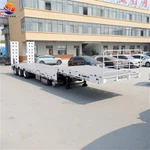


Modular Heavy Haul Trailer
Instead of a fixed trailer structure, the modular system allows individual axle modules to be joined into a unified transport platform tailored to the exact requirements of the load.
A modular heavy haul trailer is selected when conventional lowbed or flatbed trailers cannot provide the required payload capacity, deck configuration, or axle-load distribution.
Instead of a fixed trailer structure, the modular system allows individual axle modules to be joined into a unified transport platform tailored to the exact requirements of the load.
Depending on operational requirements, the system can be configured with:
Multiple hydraulic axle lines
Variable deck lengths and widths
Hydraulic suspension cylinders
Adjustable loading platforms
Modular longitudinal and transverse connectors
Heavy-duty load-bearing decks
Hydraulic or mechanical steering systems
Specialized gooseneck and drawbar arrangements
Cargo-specific mounting and lashing points
The exact configuration is determined by the physical characteristics of the cargo and the transport route rather than selected solely by nominal trailer payload.
Key Technical Specifications
|
Item |
Configuration |
|
Trailer Type |
Modular Hydraulic Heavy Haul Trailer |
|
Primary Application |
Oversized and overweight cargo transport |
|
Axle Configuration |
Project-specific modular arrangement |
|
Module Combination |
Longitudinal and transverse modular links |
|
Suspension System |
Hydraulic suspension with adjustable stroke |
|
Deck Width |
Customized according to cargo footprint |
|
Deck Length |
Modular, project-specific assembly |
|
Deck Height |
Hydraulically adjustable |
|
Steering System |
Hydraulic or mechanical steering, configuration-dependent |
|
Load Capacity |
Calculated based on axle-line quantity and layout |
|
Main Structure |
High-strength structural steel |
|
Braking System |
Air brake system configured to destination standards |
|
Kingpin / Coupling |
Selected to match tractor and transport setup |
|
Hydraulic System |
Power pack and control system matched to trailer layout |
|
Tires & Axles |
Rated for heavy axle-load operation |
|
Surface Treatment |
Shot blasting and protective coating |
Typical Applications
Power Generation Equipment: Transporting heavy power transformers, stators, generators, and turbine components.
Industrial Machinery: Moving large industrial presses, heavy manufacturing assemblies, and factory equipment.
Oil & Gas Equipment: Hauling heavy pressure vessels, distillation columns, industrial tanks, and refinery modules.
Mining Equipment: Transporting oversized mining machinery, structural assemblies, and heavy replacement components.
Infrastructure Projects: Hauling bridge girders, large structural steel elements, and heavy civil engineering components.
Modular Configuration for Different Loads
Cargo Weight
The required number of axle lines is selected based on total gross weight, allowable local axle loading, and trailer self-weight.
Cargo Dimensions
Deck length and width are configured around the actual footprint of the load to eliminate excessive overhang and maintain stability.
Center of Gravity
Cargo center-of-gravity data determines the correct longitudinal and transverse positioning of the trailer modules.
Loading Method
The trailer layout is coordinated with site loading equipment, including cranes, hydraulic lifting systems, ramps, or sliding systems.
Transport Route
Road width, turning radii, bridge weight limits, gradients, and legal axle-load regulations are factored into the final configuration.
Axle and Module Configuration
Selecting a heavy-haul trailer requires evaluating more than total cargo weight. Configurations depend on:
Permissible legal axle loads
Number of wheels per axle line
Cargo center of gravity
Load transfer points
Tractor pulling capacity
Steering geometry and maneuverability
Steering Options
Maneuverability during heavy-haul transport depends heavily on steering geometry. Depending on the trailer series and project requirements, steering can be configured for:
Tight construction-site access
Industrial plant access roads
Complex curved transport routes
Low-speed heavy transport combinations
Long modular trailer assemblies
How to Select the Right Configuration
Before requesting a technical quotation, prepare the following operational data:
Cargo Weight: Total gross weight and weight distribution details.
Cargo Dimensions: Overall length, width, and height.
Center of Gravity: Approximate vertical and horizontal center of gravity.
Loading Points: Contact areas, support feet, or saddles where the load rests on the trailer.
Required Deck Height: Maximum allowable transport height or ground clearance requirements.
Transport Route: Destination country, road conditions, and known regulatory restrictions.
Tractor Specifications: Tractor brand, model, fifth-wheel capacity, and hydraulic/braking connections.
Required Quantity: Single project requirement or multi-axle fleet purchase.
Manufacturing and Quality Control
Heavy-haul trailer performance relies heavily on structural fabrication accuracy and component quality. Production operations incorporate advanced manufacturing and inspection equipment:
Plate Preparation: CNC plasma and laser cutting machines ensure precise dimensional accuracy for structural components.
Welding Operations: Automatic and semi-automatic welding stations ensure consistent weld penetration and structural integrity.
Structural Inspection: Non-destructive testing, including X-ray and ultrasonic inspection of critical welds.
Machining & Assembly: Precision line-boring and hydraulic system assembly.
Surface Treatment: Shot blasting followed by multi-layer industrial coating.
Final Testing: Dimensional verification, functional hydraulic testing, and alignment checks prior to delivery.
FAQ
Q: What is a modular heavy haul trailer?
A: A modular heavy haul trailer is a configurable hydraulic transport system composed of interchangeable axle modules. It is designed to transport oversized and overweight loads by combining modules to match the required weight capacity and platform size.
Q: What is the difference between a modular trailer and a lowbed trailer?
A: A lowbed trailer features a fixed frame and a set number of axles. A modular trailer uses connectable axle modules, allowing transport engineers to adjust length, width, and axle distribution to suit specific project cargo.
Q: How many axle lines are required for a transport project?
A: The required number of axle lines depends on the total cargo weight, local axle-load legal limits, cargo center of gravity, trailer self-weight, and route restrictions. Calculations are performed for each specific transport project.
Q: Can the trailer width and length be adjusted?
A: Yes. Modular combinations can be assembled in various lengths and widths (including side-by-side multi-combination setups) depending on cargo dimensions and route parameters.
Q: Can the deck height be adjusted?
A: Yes. Integrated hydraulic suspension allows the platform to be raised, lowered, and leveled within its operating stroke range.
Q: Can the trailer transport heavy transformers?
A: Yes. Modular heavy-haul configurations are commonly used for transporting power transformers, generators, and large industrial vessels, provided the weight, support points, and route are properly engineered.
Hot Tags: modular heavy haul trailer, China modular heavy haul trailer manufacturers, curtain side semi trailer, semi trailer dealer, semi trailer efficiency, semi trailer payload, semi trailer suggestion, tri axle semi trailer
You Might Also Like


Send Inquiry