

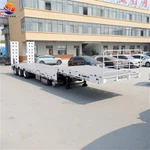


Heavy Equipment Haul Semi Trailer
Heavy Equipment Haul Semi Trailers are built for transporting excavators, bulldozers, wheel loaders, cranes, mining machinery, and other heavy or oversized equipment. The trailer configuration is selected according to actual cargo weight, equipment dimensions, loading method, axle-load requirements, and destination-market regulations. Available configurations can include lowbed, lowboy, gooseneck, removable gooseneck, and multi-axle designs, depending on the transport requirement.
Heavy Equipment Haul Semi Trailer Specifications
|
Item |
Typical Configuration / Options |
|
Trailer Type |
Heavy Equipment Haul Semi Trailer / Lowbed / Lowboy |
|
Axle Configuration |
3 Axles / 4 Axles / Multi-Axle |
|
Deck Type |
Fixed Lowbed / Extendable Deck |
|
Gooseneck |
Fixed / Detachable, depending on configuration |
|
Suspension |
Mechanical / Hydraulic |
|
Loading System |
Hydraulic Ramp / Foldable Ramp / Customized |
|
Brake System |
Air Brake with ABS, according to market requirement |
|
Main Frame |
Reinforced high-strength steel structure |
|
Kingpin |
2" / 3.5", subject to tractor configuration |
|
Landing Gear |
Heavy-duty landing gear |
|
Tires |
Selected according to axle load and destination market |
|
Wheel Rims |
Steel or aluminum alloy options |
|
Deck Width |
Customized according to cargo and road requirements |
|
Deck Length |
Customized according to cargo dimensions |
|
Payload |
Determined by trailer configuration, axle arrangement, and applicable regulations |
|
Overall Dimensions |
Customized according to cargo and destination-market requirements |
Main Frame and Load-Bearing Structure
For heavy equipment transport, frame design is one of the most important purchasing factors. Standard lowbed configurations use high-strength steel for the main load-bearing structure. A current 13 m lowbed specification lists a 14 mm upper main beam, 16 mm lower main beam, and 20 mm vertical plate. These values are configuration-specific and should not be treated as universal specifications for every heavy-haul trailer.
For a new trailer, the frame can be specified according to:
Equipment operating weight
Concentrated wheel or track loads
Axle arrangement
Deck length
Deck height
Road conditions
Required payload
Loading and unloading method
This approach is more useful than specifying a single nominal payload without considering load distribution.
Heavy Equipment Haul Trailer Configuration Options
Different cargo creates different trailer requirements.
For Excavators
• Operating weight: Verify machine mass distribution.
• Track width: Match internal and external track dimensions to deck width.
• Overall length: Confirm boom and arm position during transport.
• Deck height: Ensure clearance under low bridges and cables.
• Loading ramp angle: Prevent track damage during self-loading.
For Bulldozers
• Track load: Evaluate concentrated weight points on the deck plates.
• Blade dimensions: Verify if the blade exceeds standard width limits.
• Center of gravity: Position relative to axle groups.
• Tie-down arrangement: Secure heavy crawler units effectively.
For Wheel Loaders
• Wheelbase & overall width: Fit within platform boundaries.
• Bucket dimensions: Account for front overhang.
• Axle-load distribution: Balance steering and drive axle weights.
For Cranes and Industrial Equipment
• Concentrated loads: Prevent frame deflection under point loads.
• Long wheelbases: Select appropriate deck lengths or extendable sections.
• Route restrictions: Match axle spacing to local bridge formula laws.
Manufacturing and Quality Control
A heavy-haul trailer should be evaluated through its manufacturing process rather than appearance alone. Manufacturing facilities utilize more than 118 production and testing-related equipment items, including CNC cutting machines, automatic welding equipment, CNC plasma cutting machines, X-ray inspection equipment, and wheel-alignment equipment.
For a heavy equipment haul trailer, relevant production controls include:
Steel cutting and preparation
Structural member fabrication
Frame welding
Dimensional inspection
Component installation
Brake-system inspection
Axle and wheel alignment
Surface treatment
Final assembly inspection
Where applicable, inspection records and configuration details can be confirmed during the production and delivery process.
How to Choose the Right Heavy Equipment Haul Trailer
Instead of starting with the trailer's nominal tonnage, provide the following cargo information:
Equipment type: Excavator, bulldozer, crane, loader, mining machine, or other equipment.
Operating weight: Provide actual operating weight rather than an approximate category.
Overall dimensions: Length × width × height.
Loading method: Self-propelled loading, crane loading, or other method.
Required deck dimensions: Specify minimum usable deck length and width if already known.
Tractor information: Truck make/model, fifth-wheel height, kingpin specification, and available towing capacity.
Destination market: Country and, where relevant, operating region.
Road restrictions: Maximum axle load, total combination weight, width, or height restrictions.
FAQ
Q: How do I determine whether I need a 3-axle or multi-axle heavy haul trailer?
A: Axle selection depends on the total cargo weight, local road regulations, and maximum legal axle-load limits. Heavy equipment exceeding standard highway limits requires multi-axle configurations to distribute weight safely across the road surface.
Q: Can the deck width and length be customized for wide mining machinery?
A: Yes. Deck dimensions, outrigger brackets, and side extensions can be customized to support oversized equipment while maintaining road compliance where applicable.
Q: What is the advantage of a low deck height when hauling excavators?
A: A lower deck height reduces the overall vertical profile of the loaded combination, helping the vehicle pass safely under low bridges, overhead utility lines, and tunnel clearances.
Q: Are hydraulic ramps necessary for tracked equipment?
A: Hydraulic ramps provide a gradual loading angle and stable transition for heavy tracked vehicles like excavators and bulldozers, reducing the risk of slippage or structural strain during self-loading.
Q: What technical details are needed to request an accurate quotation?
A: An accurate configuration requires equipment type, operating weight, precise dimensions (length, width, height), loading method, tractor specs, and the destination country's road regulations.
Hot Tags: heavy equipment haul semi trailer, China heavy equipment haul semi trailer manufacturers, semi trailer conference, semi trailer dimensions, semi trailer experts, semi trailer hub, semi trailer spare parts, warehousing special trailer
You Might Also Like



Send Inquiry