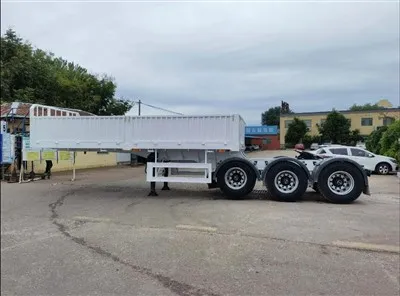
As a leading supplier of tank trailers, I'm often asked about the intricate workings of the monitoring devices installed on our products. These devices are crucial for ensuring the safety, efficiency, and proper operation of tank trailers, whether they are Water Tank Trailer, Fuel Tank Trailer, or LNG CNG Tank Trailer. In this blog, I'll delve into the science behind how these monitoring devices function and why they are indispensable for modern tank trailer operations.


The Basics of Tank Trailer Monitoring Devices
At the core, tank trailer monitoring devices are designed to collect, analyze, and transmit data related to various parameters within the tank. These parameters can include the level of the liquid or gas inside the tank, the temperature, pressure, and even the integrity of the tank structure. By continuously monitoring these factors, operators can detect potential issues early and take proactive measures to prevent accidents, ensure regulatory compliance, and optimize the use of the tank trailer.
Level Monitoring
One of the most critical functions of a tank trailer monitoring device is to measure the level of the liquid or gas inside the tank. This information is essential for determining how much product is in the tank, estimating the remaining capacity, and preventing overfilling or running out of product during transportation.
There are several methods used to measure the level in a tank trailer. One common approach is the use of ultrasonic sensors. These sensors emit high - frequency sound waves that bounce off the surface of the liquid or gas in the tank. By measuring the time it takes for the sound waves to return to the sensor, the device can calculate the distance to the surface and thus determine the level of the contents. Ultrasonic sensors are non - intrusive, which means they do not come into direct contact with the product in the tank, making them suitable for a wide range of applications, including those involving corrosive or hazardous substances.
Another method is the use of float - type sensors. These sensors consist of a float that rises and falls with the level of the liquid in the tank. The position of the float is then translated into an electrical signal, which can be used to indicate the level on a display or transmit the data to a central monitoring system. Float - type sensors are simple, reliable, and relatively inexpensive, but they may not be as accurate as ultrasonic sensors, especially in tanks with turbulent or sloshing liquids.
Temperature Monitoring
Temperature is another important parameter to monitor in a tank trailer. Different products have specific temperature requirements for safe storage and transportation. For example, some fuels need to be kept within a certain temperature range to prevent vaporization or degradation, while liquefied gases like LNG need to be maintained at extremely low temperatures.
Thermocouples and resistance temperature detectors (RTDs) are commonly used to measure the temperature in tank trailers. Thermocouples work based on the principle of the Seebeck effect, where a voltage is generated at the junction of two different metals when there is a temperature difference between the junction and the reference point. RTDs, on the other hand, rely on the change in electrical resistance of a metal wire with temperature. Both types of sensors are accurate and can provide real - time temperature data, which can be used to trigger alarms if the temperature goes outside the acceptable range.
Pressure Monitoring
Pressure monitoring is crucial for ensuring the safety of the tank trailer, especially when transporting pressurized gases or liquids. Excessive pressure can lead to tank rupture, leakage, or other dangerous situations.
Pressure sensors, such as strain - gauge sensors, are commonly used to measure the pressure inside the tank. These sensors work by detecting the deformation of a diaphragm or a strain - sensitive element caused by the pressure of the fluid in the tank. The deformation is then converted into an electrical signal, which can be used to display the pressure on a gauge or transmit the data to a monitoring system. Pressure sensors are highly accurate and can detect even small changes in pressure, allowing operators to take immediate action if there is a pressure anomaly.
Structural Integrity Monitoring
In addition to monitoring the contents of the tank, some advanced monitoring devices can also assess the structural integrity of the tank trailer. This is important because a damaged or weakened tank can pose a significant safety risk.
Acoustic emission sensors can be used to detect the presence of cracks or other structural defects in the tank. These sensors pick up the high - frequency sound waves generated by the growth of cracks or the movement of materials under stress. By analyzing these acoustic emissions, the monitoring device can identify potential structural problems before they become critical.
Data Transmission and Communication
Once the monitoring device has collected the data, it needs to transmit this information to the operator or a central monitoring system. This can be done through various communication methods.
Wired communication, such as Ethernet or RS - 485, is a reliable option for transmitting data over short distances. It provides a stable connection and allows for high - speed data transfer. However, it may not be practical for mobile applications like tank trailers, where flexibility and the ability to operate in different locations are required.
Wireless communication technologies, such as cellular networks, Wi - Fi, or satellite communication, are increasingly being used for tank trailer monitoring. These technologies allow the monitoring device to transmit data from anywhere, enabling real - time monitoring and remote access to the data. For example, an operator can use a smartphone or a computer to check the status of the tank trailer while it is on the road or at a remote location.
Benefits of Tank Trailer Monitoring Devices
The use of monitoring devices on tank trailers offers numerous benefits. Firstly, it enhances safety by providing early warning of potential problems, such as overfilling, excessive pressure, or temperature fluctuations. This allows operators to take preventive measures and avoid accidents that could lead to environmental damage, injury, or loss of life.
Secondly, it improves efficiency. By accurately monitoring the level, temperature, and other parameters, operators can optimize the use of the tank trailer, reduce waste, and ensure that the product is transported under the best possible conditions. For example, they can plan refills more effectively and avoid unnecessary stops to check the status of the tank.
Finally, it helps with regulatory compliance. Many industries have strict regulations regarding the transportation of hazardous materials, and monitoring devices can provide the necessary documentation and data to demonstrate compliance with these regulations.
Conclusion
In conclusion, tank trailer monitoring devices play a vital role in the safe and efficient operation of tank trailers. By continuously monitoring the level, temperature, pressure, and structural integrity of the tank, these devices provide valuable information that can help prevent accidents, optimize operations, and ensure regulatory compliance.
If you are in the market for a tank trailer and are interested in learning more about our products and the advanced monitoring devices we offer, we encourage you to reach out to us for a detailed discussion. Our team of experts is ready to assist you in selecting the right tank trailer for your specific needs and to answer any questions you may have.
References
- "Tank Gauging Handbook" by Honeywell.
- "Industrial Instrumentation and Control Handbook" by CRC Press.
- Various industry standards and guidelines related to tank trailer safety and monitoring.